Workflow
What the crew reads between the lines
· 5 min read
In short
Crews read a preference sheet for what it implies as well as what it says; they provision from it before the guests arrive. Missing detail is the expensive mistake. Every broker's sheet arriving in a different layout costs the interior time it doesn't have. A detailed sheet per guest, in the same order every time, solves both.
A yacht's executive chef once described his first step with a new charter: read each guest's preference sheet slowly and try to put himself in the shoes of the person who wrote it. Small details, he said, such as a choice of wine or cheese or the way someone likes dinner served, "can speak volumes". From those he builds a profile of each guest before anyone has stepped on board.
That's how preference sheets are read on the other side. The broker sends a form; the crew receives evidence.
What a sheet says without saying it
Almost every answer carries more than its words. Breakfast at seven, lunch on board every day and dinner ashore most nights describes a group that wants to be up and out, so the captain plans the anchorages around early starts. A request for quiet bays at night next to a list of beach clubs says the afternoons and the evenings are two different holidays. Six bottles of champagne for two guests is a celebration, whether or not anyone wrote the word anniversary. A diver with plenty of logged dives but no dive in three years is a refresher before anything ambitious.
Crews also read for contradictions. A chef interviewed in the trade press described a group whose sheet said no desserts; once aboard, they wanted dessert with every meal. Another was told by a broker that a client had recently had a heart attack and ate only very healthy food; the way it was put, the man sounded close to death. Both stories point the same way. The closer the answers come from the guest, the less the crew has to second-guess. The more there is to read, the better the reading.
Too little costs more than too much
By the time the guests arrive, the provisioning is done. A charter captain put it plainly in an interview: guests who change their mind about a sheet they wrote two weeks earlier can't expect a different meal, because the yacht has already provisioned. Chefs are advised to buy speciality items before the charter, not to count on finding them in port. In remote places there's no second chance. One crew member was sent up an estuary, about 50 miles from the nearest township, to find ricotta because the guests' sheet listed it and the crew had underestimated how much they would eat.
So a sheet with too little in it is the costly kind. An allergy left off, a quantity guessed, a birthday nobody mentioned: none of those can be fixed at anchor.
There's a catch worth being precise about. More detail isn't the same as a longer shopping list. An industry opinion piece described a generic Mediterranean sheet sent to guests chartering in the South Pacific, which led to Dover sole being flown into a Polynesian lagoon while the local catch went ignored. What crews need more of is detail about people: quantities, brands, routines, occasions, how severe the allergy is. A sheet built around those answers tells the chef what to buy; a sheet built around a long tick list only tells him what was on the form.
One layout, every time
A charter yacht doesn't work with one broker. Over a season the sheets arrive from many of them. A stewardess quoted in the trade press summed up the result: every broker asks different questions, some useful to the crew and some useful mainly to the broker.
The interior then does the same job every time. A former chief stew who worked on more than a dozen yachts traced many problems on board back to poor preference information. Her advice to crews describes the work: one person, usually the chief or second stew, owns a master copy and keeps adding to it from emails, group chats and notes, then prints packets for the crew mess, the pantry and the galley. A busy stew may only have a second to glance at one between guests, so the most important information belongs at the top.
Every new layout from a new broker adds to that job. The allergies are on page one of one sheet and page four of the next; one form asks about wine by the bottle, another just asks "drinks?". A sheet that arrives in an order the crew already knows can be read in the time they have, then copied into their own packet without anything falling through.
How the CharterRoutes sheet is built
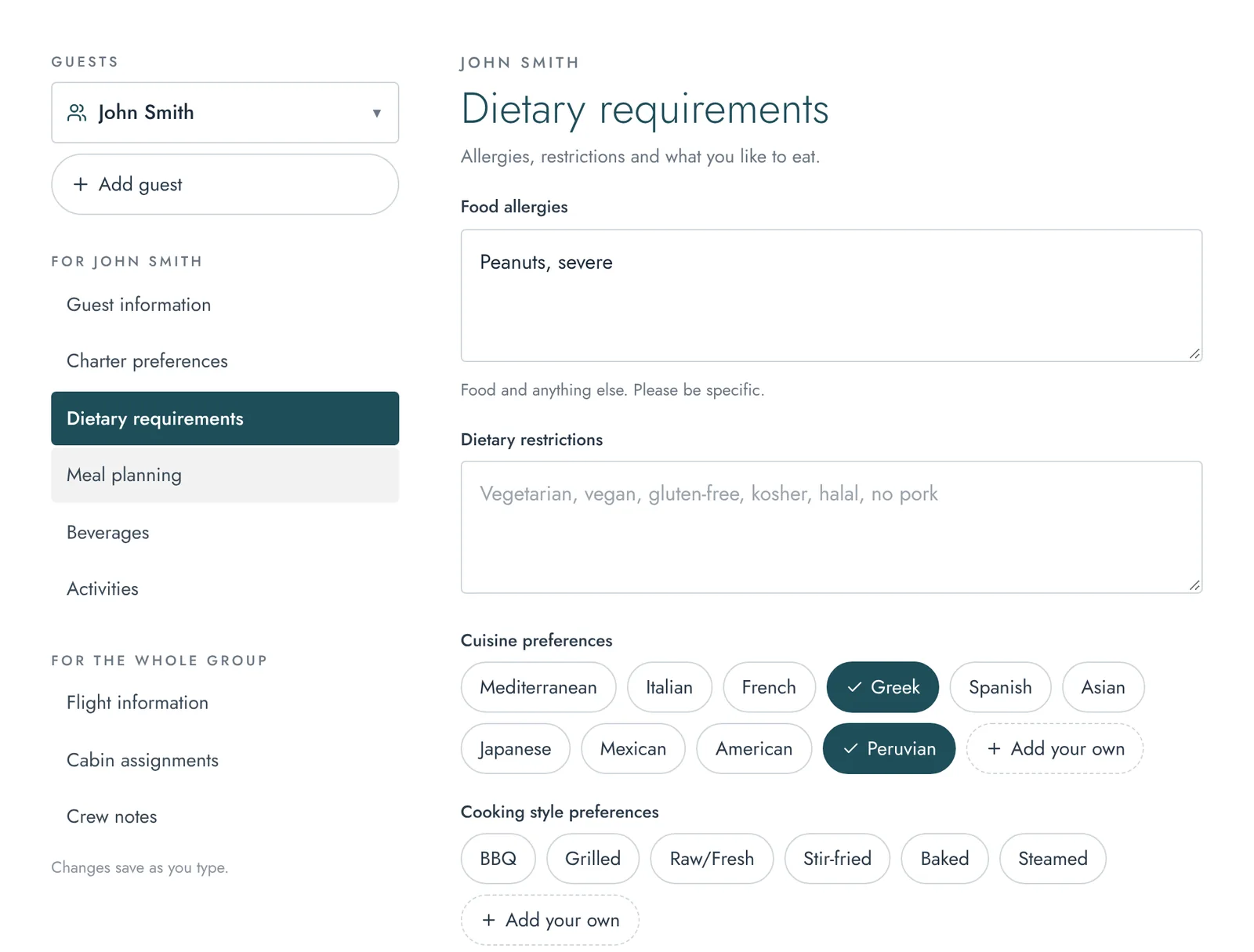
The client gets one link for the whole group and adds each guest by name. Every guest answers for themselves: allergies with how severe they are, diet, meal times and how often they want to eat on board, wine by type, brand or region, quantity and budget, beer and water by the bottle, activities and diving down to certification and the date of the last dive. Special occasions are entered with whose they are and the date. The group's flights, cabins and notes for the captain and the chef are asked once.
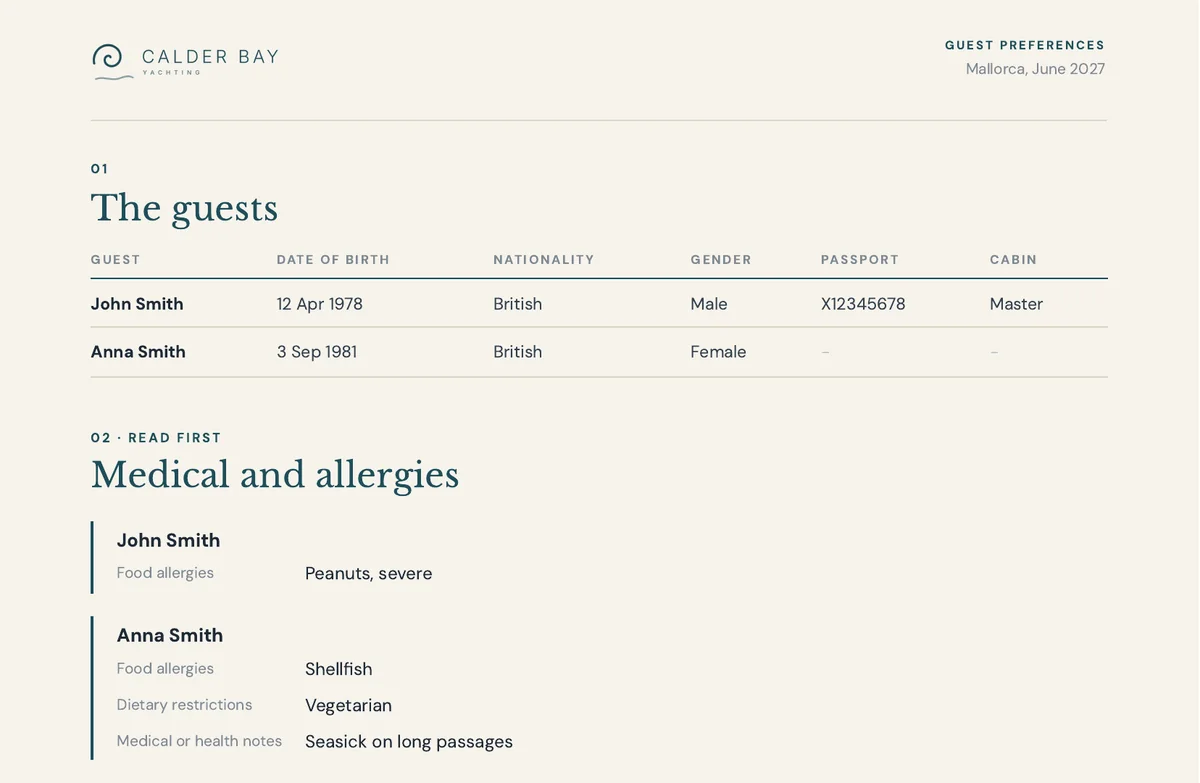
The crew's PDF always comes in the same order, whichever broker sends it. The guest list comes first, medical notes and allergies straight after it, then flights, cabins, each guest's diet, meals, drinks and activities, notes for the crew and a one-page quick reference with guest, cabin, allergies, diet and breakfast. Empty sections are left out, so a short sheet and a full one read the same way. The sheet stays in the broker's account under the client's name, ready for the next charter.
Questions
Why do yacht crews want detailed preference sheets?
Because the yacht is provisioned from the sheet before the guests arrive, often in places where nothing can be bought later. Crews also read the answers for what they imply about routines and the style of the week. A missing allergy, quantity or occasion can't be fixed at anchor; an unneeded detail can simply be ignored.
Why does the layout of a preference sheet matter to the crew?
Crews receive sheets from many brokers, each with different questions in a different order. The interior often rebuilds them into its own master copy. A sheet that always arrives in the same order, with allergies near the top, is faster to read and safer to copy.
What does a CharterRoutes preference sheet ask?
Per guest: personal and travel details, charter wishes, allergies with their severity, diet, meal routines, drinks with brands and quantities, activities and diving. For the group: flights, cabins and notes for the captain, the chef and the crew. Each guest fills in their own part through one shared link.
Sources: interviews with yacht chefs, stewards, captains and charter managers in the yachting trade press.
Itineraries, offers and preference sheets in one place
Plan the week on a map or from one sentence, put the yachts side by side and send it all under your own brand. Free to start, 3 downloads, no card.
Start free